

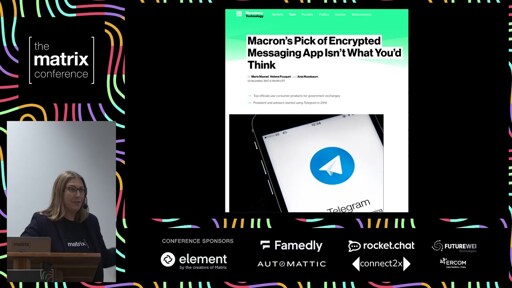
Matrix was built to become the open communication of the web and serve everyone. But, as the Internet and email did, its network effect started with governments. Today, and as proven by the audience in the room, most European governments and several others are either using it or looking at implementing it for their communications. This talk will tell the story of how we got there and why.
Interesting, how does that verification process work? I’ve never really used matrix so I’m curious.
(Sorry about the length, I’m rather passionate about this. The second half can be ignored)
Essentially, the key to decrypt your old messages is tied to your session. On your (presumably) first session, you can get a recovery key, which is a long hexadecimal string, and a recovery passphrase which you can decide yourself.
If you start a new session (i.e., you log in on another client), for your opd messages to be visible on the new one and your new messages on the ols one, you need to “verify” the new session. There are three ways you can do this.
Alternatively, if you forgot your key and your passphrase and logged out on all the other sessions, you can reset your recovery key, creating a new one and making your old messages unreadable.
(The following are just my thoughts on this) The recovery key is a PITA because most non-technical people I know don’t use password managers. Even if they did, though, it’s not like any password manager (afaik) offers to save your recovery key. You need to manually put it in there, separate from your account password, and manually enter it when you’re connecting a new client.
The recovery passphrase somewhat mitigates this, as they could simply use their favourite “use it everywhere” password, but I don’t think I need to point out the problems with that.
The emoji thing is cute and works quite well, but somehow people still get confused and justifiably vaguely irritated that they have to do it at all.
You just can’t expect normal people to understand that these are important security measures, they just want to log in and be done.
That said, most people log in once on their phone, very maybe twice to also have it on their laptop and then never have to think about it again. That, however, is a problem in and of itself, because at some point they’ll get a new phone, chuck the old one, try to log in and realize they have no idea what their key is.